
Speak to an Air Purification Expert

Speak to an Air Purification Expert
Air Filtration Industry Articles, News And Resources
New Additions To Our Air Filtration Unit Lines
March 13th, 2019 | Posted in Air Cleaners

MistBuster® and MX-Series Air Quality Engineering, Inc. manufactures a wide variety of products to filter machine-tool mist, smoke, dust and other airborne contaminants associated with machining operations. The MistBuster® product line provides source filtration, and the MX-Series provides centralized filtration. The photo on the left shows a MistBuster® 500, which provides variable airflow up to 500 CFM. On the right is an M466O unit, which provides airflow up to 8,000 CFM. Whether your need is…
Continue Reading »Kitchen Exhaust PCU/Exhaust Scrubber
January 21st, 2019 | Posted in Air Cleaners
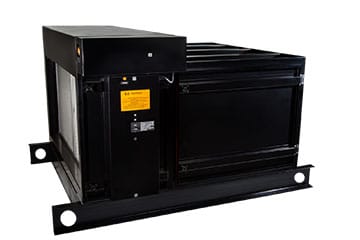
Kitchen Exhaust Scrubbers (or Pollution Control Units (PCUs)) are becoming more and more popular as urban areas continue to grow and mixed-use construction becomes increasingly more popular. But just what are these units and how do they work? There are several different technologies on the market for capturing the grease, smoke and odors from commercial kitchen exhaust, but let’s look at the two most popular technologies that are used today. Mechanical Media Filtration Mechanical Media…
Continue Reading »MERV Rating
August 6th, 2018 | Posted in Air Cleaners
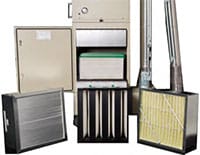
One common term used when discussing air filtration is the MERV rating. Take a moment to understand what MERV ratings are, and how they applied to your application. Before delving in, it helps to know that MERV is an acronym for Minimum Efficiency Reporting Value, and it is a standard scale used to rate the effectiveness of air filters in terms of filtering particulate from the air. MERV Scale The American Society of Heating, Refrigeration…
Continue Reading »Mechanisms Of Filtration
May 30th, 2018 | Posted in Air Cleaners
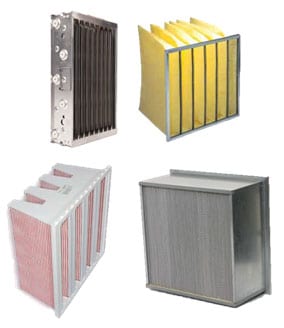
Need a brief overview of the basic five air filtration mechanisms that are used to remove particulates from the air? Then this is for you. This particular overview is tailored to mechanisms utilized on systems manufactured by Air Quality Engineering. Each air filtration mechanism, including straining, interception, diffusion, inertial impaction and electrostatic attraction, is employed to capture specific range of sizes of the particulate being filtered. The straining, interception, diffusion, and inertial impaction mechanisms rely…
Continue Reading »Breathe Purer Air In Industrial Environments
May 16th, 2018 | Posted in General

Do you want to breathe pure air? Or give your employees cleaner air to breathe while working? Of course you do. One of the unfortunate truths about today’s world is that the air we breathe is not pure. It contains many contaminants, pollutants and irritants. Most of the time we don’t notice they are there. It’s nice to breathe freely, but it can also offer a false sense of comfort in thinking that the air…
Continue Reading »Carbon Air Filtration
April 19th, 2018 | Posted in General
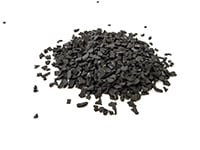
There are times when one’s air cleaning process may require the use of a carbon post filter. Let’s get a brief overview of carbon, how it works, and when you should consider using it. What is Carbon and Carbon Filtration? Carbon (sometimes referred to as activated charcoal) is typically used to address Volatile Organic Compounds, or VOC’s. VOC’s include odors and other gaseous pollutants. There is also impregnated carbon that is used to increase the…
Continue Reading »Troubleshooting An Electrostatic Cell
March 7th, 2018 | Posted in Air Cleaners
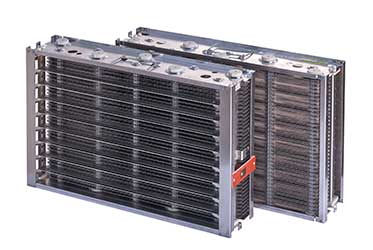
If you know what to look for when troubleshooting an electrostatic cell it is a fairly easy process. I will go over the general troubleshooting of an electrostatic cell in this blog, and this covers all electrostatic cells we sell. If your electrostatic cell has not been cleaned for a while, it is important that the electrostatic cell is thoroughly cleaned before troubleshooting. You can find additional information on cleaning an electrostatic cell here. Notice:…
Continue Reading »Isolation, Source, And Ambient Capture
February 7th, 2018 | Posted in Air Cleaners
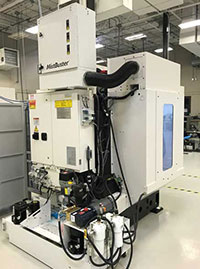
A common question comes up very frequently, and that is “how do you determine if you should do source capture or ambient capture?” Well, the simple answer is you should do source capture; however it is not always convenient or possible to do source capture. What I am going to talk about is the pros and cons of doing isolation, source, and ambient capture. Yes, I just threw isolation capture in there. A lot of…
Continue Reading »Kitchen Exhaust PCU Efficiency
December 14th, 2017 | Posted in Air Cleaners
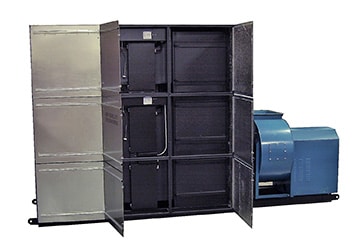
When sizing a kitchen exhaust pollution control unit, we typically recommend about 2,000 CFM per full size industrial electrostatic cell. Then to achieve higher airflows, we will add more cells in various configurations to maintain 2,000 CFM or less per cell. If you look at the single cell efficiencies graph below, you can see efficiencies graphed for several airflows. If a higher efficiency is required, we will recommend a lower CFM per electrostatic cell to…
Continue Reading »Motorized Impeller Changes To MistBuster® Improves Performance Greatly
November 16th, 2017 | Posted in Air Cleaners
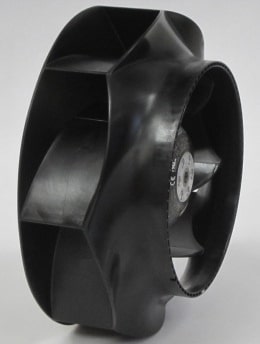
We are excited to announce that we have changed the motorized impellers in our MistBuster® line to a new design that significantly improves performance while also improving efficiency. The new motorized impeller has a single piece PA plastic injected impeller compared to our original impeller that was assembled from several pieces of cut and formed pieces of metal. The benefit of the single piece impeller is the ability to have an innovative design that was…
Continue Reading »